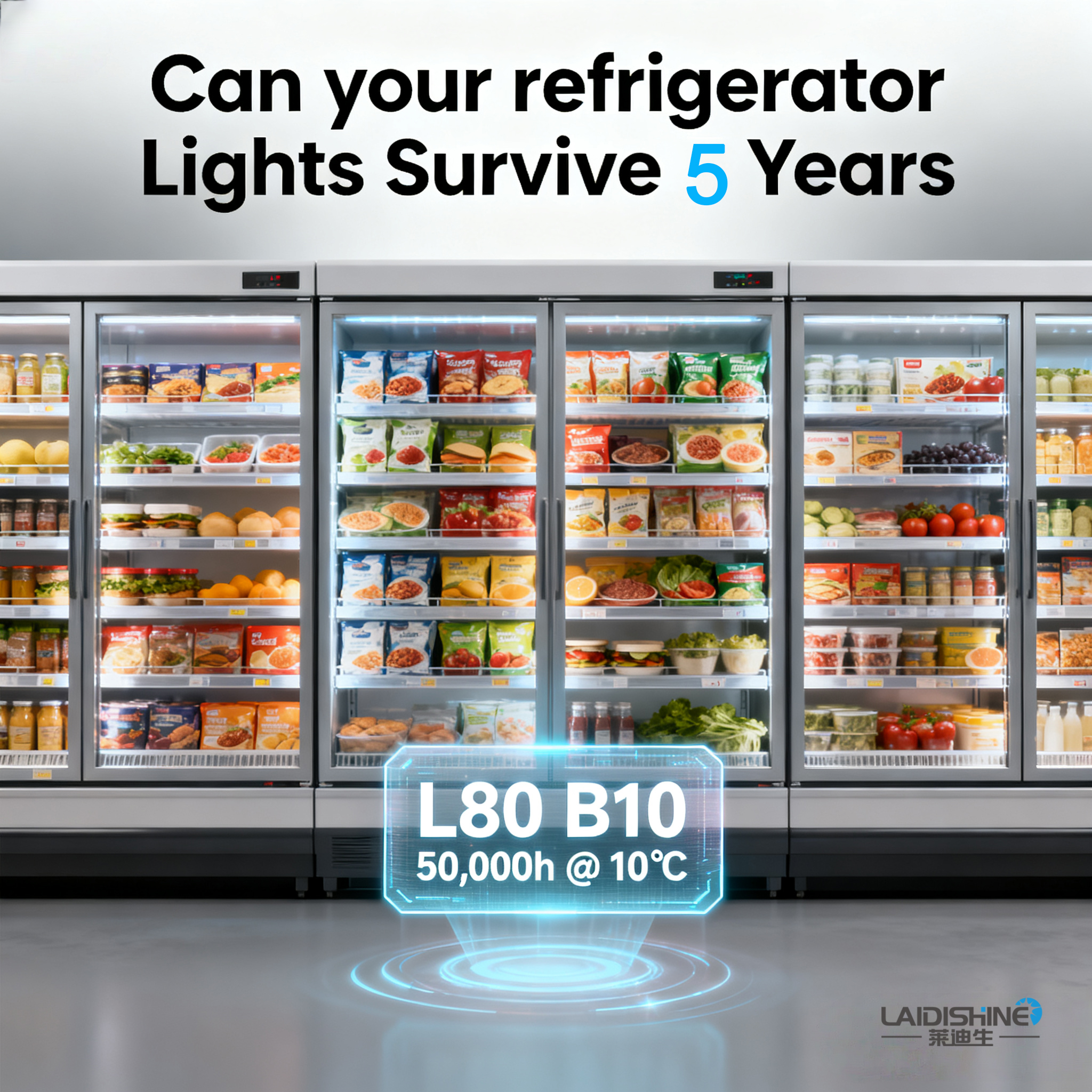
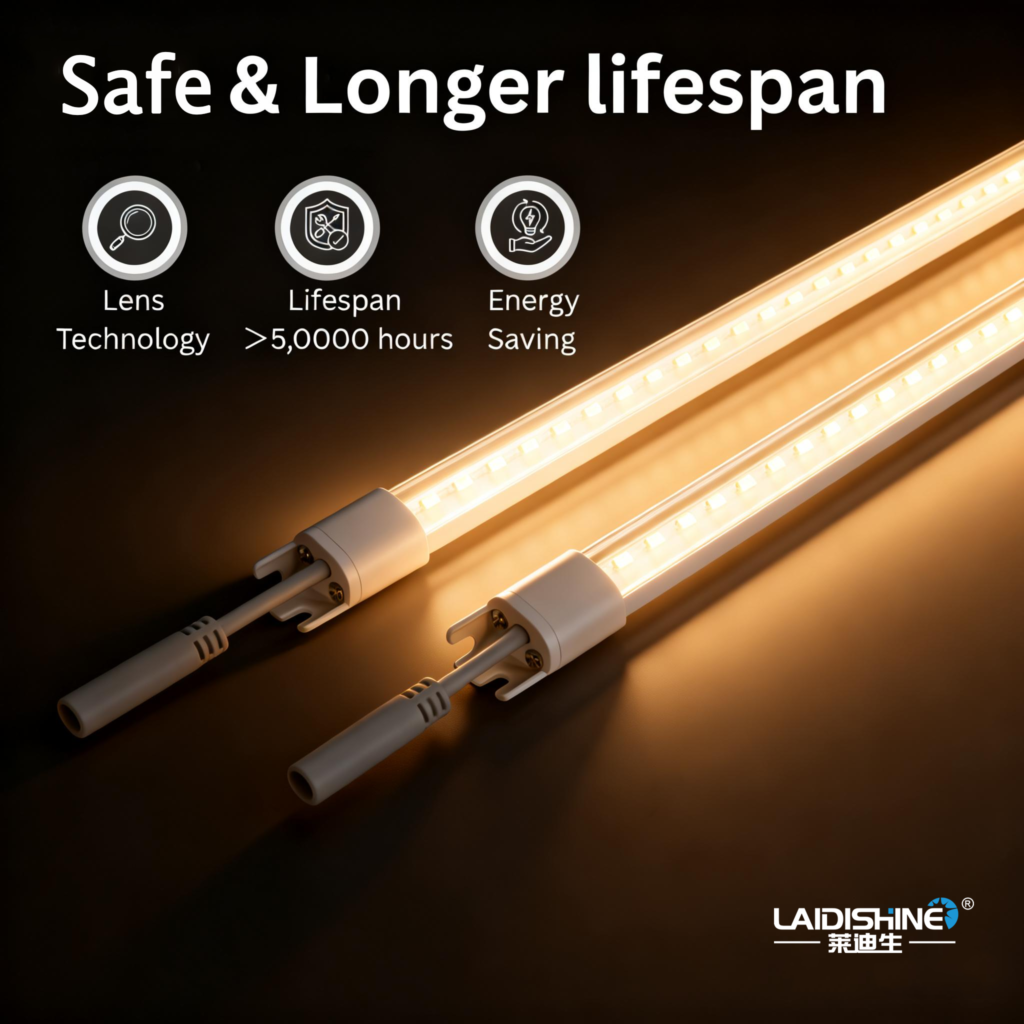
When shopping for LED lighting for commercial freezer display cases, you’ve surely come across claims like “50,000-hour lifespan” more than once.
What does 50,000 hours actually mean? If the lights run 24 hours a day, that’s roughly 5.7 years of continuous use. For supermarkets running 12–16 hours a day, it translates to 8–10+ years.
Sounds great, right? But you’ve probably also run into this frustration:
- Why do some LED lights in cold cabinets start dimming, flickering, or even burning out completely in less than two years?
- Is the “50,000 hours” a genuine promise — or just marketing hype?
The answer is: a 50,000-hour lifespan is absolutely achievable with proper design and matching, but the actual life of a light fixture is influenced by many factors.
Ⅰ. The True Meaning Behind the 50,000-Hour Rating
To begin with, it’s essential to correctly interpret the definition of lifespan for LED luminaires. The industry-standard benchmark is LM-70 (or LM-80), defined as the number of hours until luminous flux depreciates to 70% of the initial value. Put simply, 50,000 hours does not mean the light will still be on — it marks the threshold at which output has degraded to a level that is still considered acceptable.
For refrigerated display case lighting, this translates to: the first 2–3 years show virtually no perceptible brightness loss; years 4–5 may exhibit a visible dimming; and well-engineered LED fixtures continue to operate beyond their rated life with only marginal further depreciation.
II. Four Key Factors That Actually Determine Refrigeration Display Showcase Lighting Lifespan
Apart from the inherent quality of the fixture’s raw materials, the internal environmental conditions of the cold cabinet play an equally important role in determining the actual service life of the lighting.
1. Extreme Cold & Constant Temperature Swings
LED chips themselves actually become more efficient at low temperatures — that’s one of LED’s advantages. But the driver, capacitors, solder joints, and sealing materials? They hate the cold — and even more, they hate temperature swings.
Commercial freezers’ temperatures can hit -20°C, then spike above 0°C during defrost cycles. This constant thermal shock kills electrolytic capacitors in the driver, Cracks sealant and cable jackets, and creates micro-cracks on PCB boards and solder joints.
End result: The LED is fine. The driver isn’t. Light’s out.
2. Condensation & Humidity
Frost forms inside the freezer display cabinet. Defrost turns it into water. That water gets into the light — and corrodes the circuits.
Minimum requirement: IP65 rating, with sealing that survives repeated defrost cycles.
3. Driver Quality & Matching Method
LEDs are low-voltage, constant-current devices. Get the driver wrong, and nothing else matters. This is the most overlooked — yet most critical factor.
There are two common driver configurations for cold cabinet lighting:
| Type | Description | Pros |
| External Driver | The driver is housed separately from the fixture and installed in the cabinet’s external control box | Not exposed to low temperatures → longer lifespan |
| Internal Driver | The driver is built directly into the light tube | Clean, simple installation |
What Laidishine does: We use specially designed wide-temperature-range drivers (-20°C to +25°C normal operation), engineered specifically for refrigerated display showcase environments to ensure driver reliability.
4. Voltage Fluctuation & Surges
Commercial cold cabinets often share a power supply with compressors, fans, and other inductive loads.
When a compressor starts or stops, it generates voltage spikes and surges — severe enough to punch through the semiconductor components inside an LED driver.
Light fixtures without proper surge protection (such as MOVs / varistors and surge-suppression circuits) see a significantly higher failure rate in real-world settings like supermarkets and convenience stores.
III. Why Can Laidishine’s Cold Cabinet LEDs Truly Approach 50,000 Hours?
Laidishine has been deeply committed to commercial refrigeration lighting for over 13 years, serving clients including AHT, EPTA, GeneralFushi, Carrier, Anthony — the world’s leading cold cabinet manufacturers — as well as end users such as Freshippo (Hema) and Walmart.
To address the 4 real factors that affect lifespan, we tackle each one head-on in our design and production:
| Factor | Laidishine’s Solution |
| Low Temp & Thermal Cycling | Wide-temperature-range driver design (-20°C ~ +25°C), passed rigorous thermal shock testing |
| Condensation & Humidity | Fully sealed construction — all fixtures rated IP65 |
| Driver Reliability | Built-in constant-current IC, power factor >0.95, zero flicker |
| Voltage Surges | Built-in surge protection circuit, meets industrial-grade immunity standards |
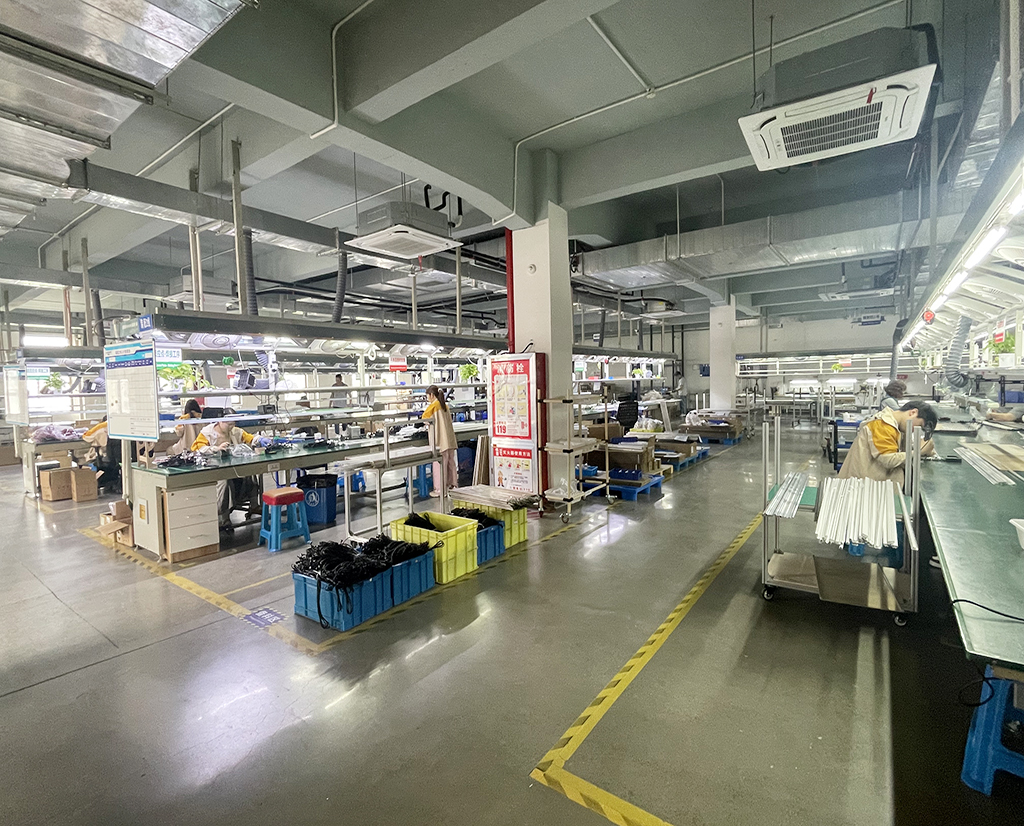
On top of that, every Laidishine LED fixture undergoes strict reliability verification before leaving the factory:
- Low-temp start-up test: Continuous operation for 72 hours at -25°C
- Voltage fluctuation & rapid on/off cycling test
The result? Our clients achieve nearly 50,000 hours of effective service life under real-world conditions — meaning ≤20% light depreciation (≥80% brightness retained) after 5+ years. Many of our customers’ fixtures have been running steadily for over 10 years with no issues.
IV. 3 Practical Tips for Cold Cabinet Manufacturers
If you’re selecting LED lighting for your cold cabinets and want long life with minimal returns, here are three things you must check:
1. Don’t Just Look at the LED Chip Brand — Look at the Driver & Seal Design
Ask your supplier directly:
- Is the driver optimized for low temperatures?
- Is the water/dust rating IP65 or higher?
- Has it passed thermal shock testing?
2. Choose a Supplier with Proven Cold Cabinet Applications & Certifications
Laidishine holds 100+ certifications, including UL, CE, RoHS, and CB, and has extensive experience partnering with top-tier cold cabinet brands. Our reliability is verifiable, not just claimed.
3. Prioritize Manufacturers Offering 3–5 Year Full-Fixture Warranty
A supplier bold enough to offer a long warranty is usually one that has real confidence in their product’s lifespan.
Achieving 50,000 hours with commercial cold cabinet LED lighting is absolutely within reach — technically.
You can keep accepting the reality of cheap lights that die in two years. Or you can choose a specialist manufacturer like Laidishine — one that has built reliability into its DNA — and let your cold cabinets benefit from low maintenance costs and premium display quality.
Visit us now:www.laidishine.com Get a custom lighting solution for your cabinet model + free sample testing support.