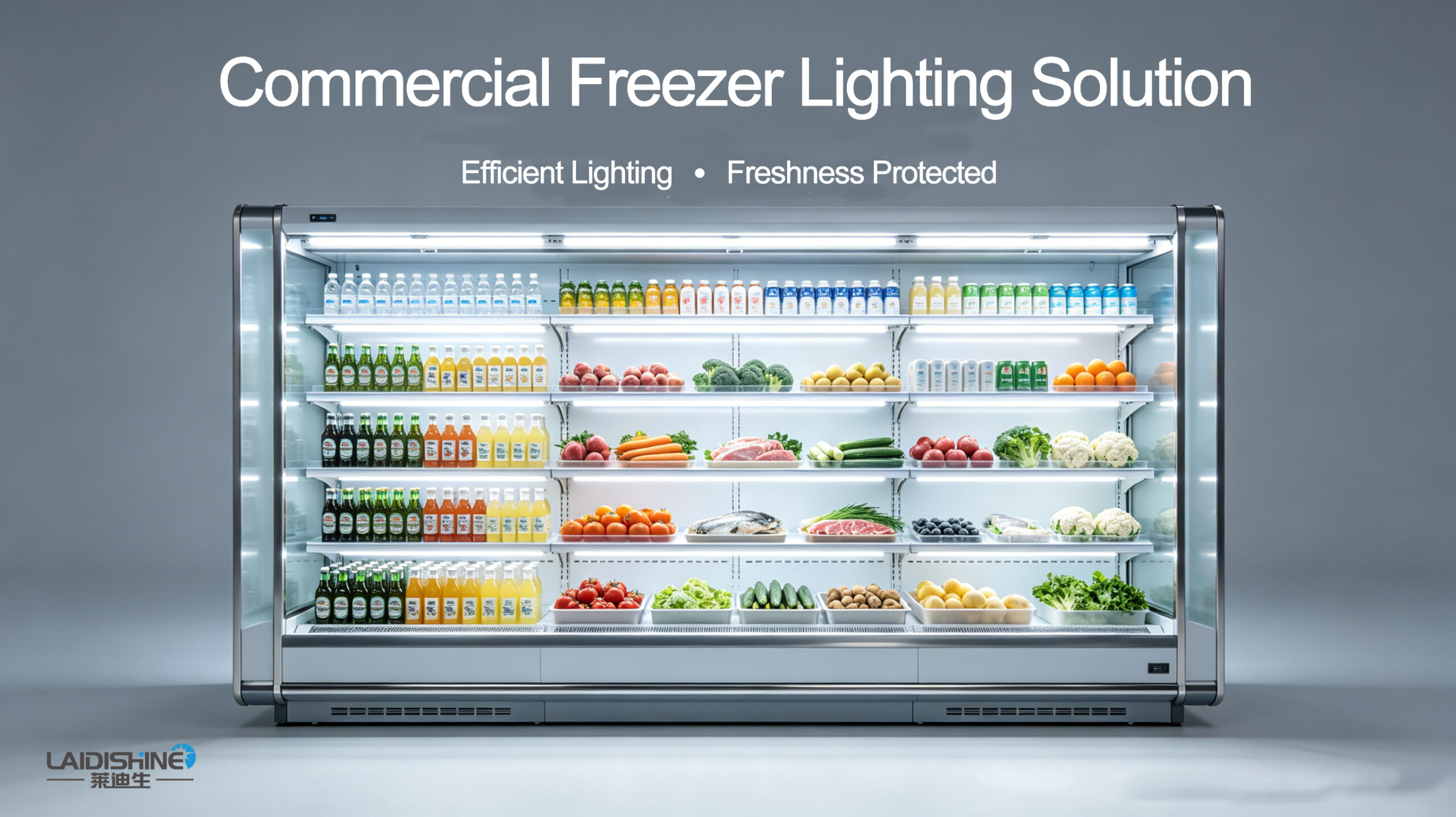

(This is Part 2 of — Lighting as a Refrigeration Load Part 1)
Introduction
In Part 1, we established a simple but often overlooked fact:
Lighting inside refrigerated display cases becomes heat — and that heat must be removed by the refrigeration system.
But in engineering practice, this is not just a theoretical concept. It is already embedded in the way refrigeration systems are designed, tested, and evaluated.
To understand why, we need to look at how industry standards treat lighting.
Lighting Is Officially Defined as Refrigeration Load
Refrigeration engineers do not guess where heat comes from. They follow structured load calculations.
According to the ASHRAE Refrigeration Handbook, cooling load inside a display case includes:
- infiltration from ambient air
- conduction through the cabinet
- radiation
- internal loads such as lights and fan motors link:
More importantly, ASHRAE makes a very direct statement:
Lighting located inside the refrigerated space must be treated as part of the refrigeration load.
This is not optional. It is part of standard engineering methodology.
Why Standards Treat Lighting This Way
From a system boundary perspective, the logic is straightforward:
- Refrigerated display case = a closed thermal system
- Any electrical energy entering that system
- → eventually becomes heat inside that system
ASHRAE load calculation principles confirm that internal electrical equipment (including lighting) is always counted as internal heat gain.
So when engineers calculate refrigeration capacity, they do not separate “lighting energy” from “cooling load”.
They combine them.
AHRI 1200: Where Lighting Becomes Measurable
While ASHRAE defines the physics, AHRI 1200 defines how performance is measured.
In real testing of refrigerated display cases:
- total energy consumption includes lighting
- lighting energy is recorded as part of system energy
- case performance ratings reflect this combined load
This means:
👉 A case with higher lighting power will always test as less energy efficient, even if the refrigeration system itself is unchanged.
The Practical Engineering Insight
For engineers working on real projects, this leads to a key understanding:
Lighting is not a “visual accessory.”
It is a permanent internal heat source.
And unlike infiltration or door openings, lighting:
- is continuous
- predictable
- fully controllable
Which makes it one of the most manageable parts of refrigeration load.
Where Most Systems Still Fall Short
In many projects, lighting is still selected based on:
- brightness
- cost
- general LED efficiency
But not based on:
- thermal impact inside the cabinet
- driver heat contribution
- heat dissipation path
This disconnect is where hidden inefficiencies appear.
Laidishine Perspective: Designed as a Thermal Component
At Laidishine, lighting is not treated as a standalone product.
It is treated as part of the refrigeration system itself.
In several retrofit projects (including supermarket fresh food zones and vertical freezer cabinets), improvements were not achieved by “more light” — but by:
- reducing unnecessary wattage
- optimizing LED layout
- controlling heat concentration inside the case
The result is not only lower energy consumption, but also:
- more stable case temperature
- reduced compressor cycling
- improved product consistency
Engineering Takeaway
ASHRAE and AHRI do not treat lighting as optional.
They treat it as part of the system.
And once you look at lighting this way, one conclusion becomes unavoidable:
Lighting design is refrigeration design.
Stay Tuned
In Part 3, we move from standards to real-world impact:
👉 How lighting power directly affects compressor runtime, energy cost, and system performance