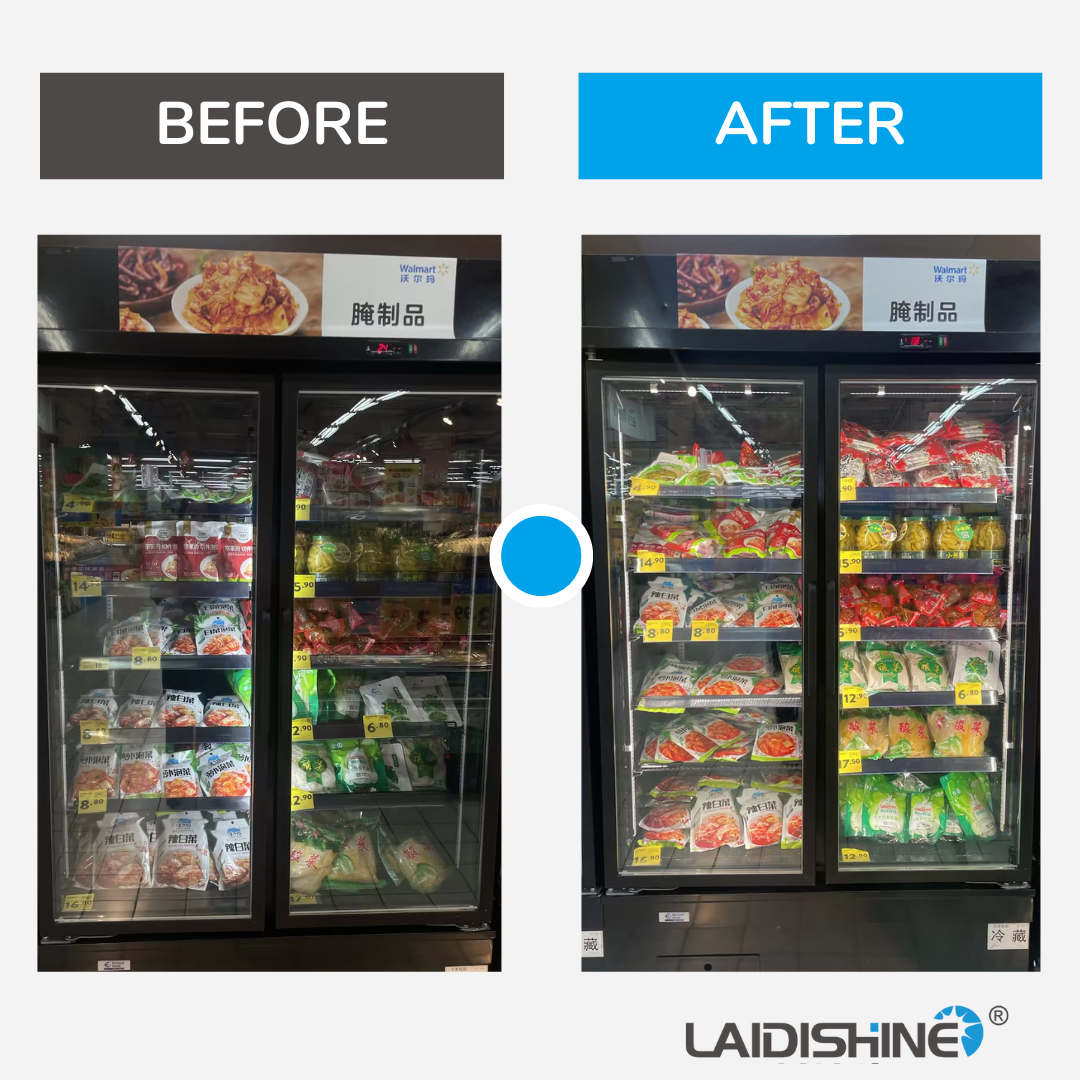
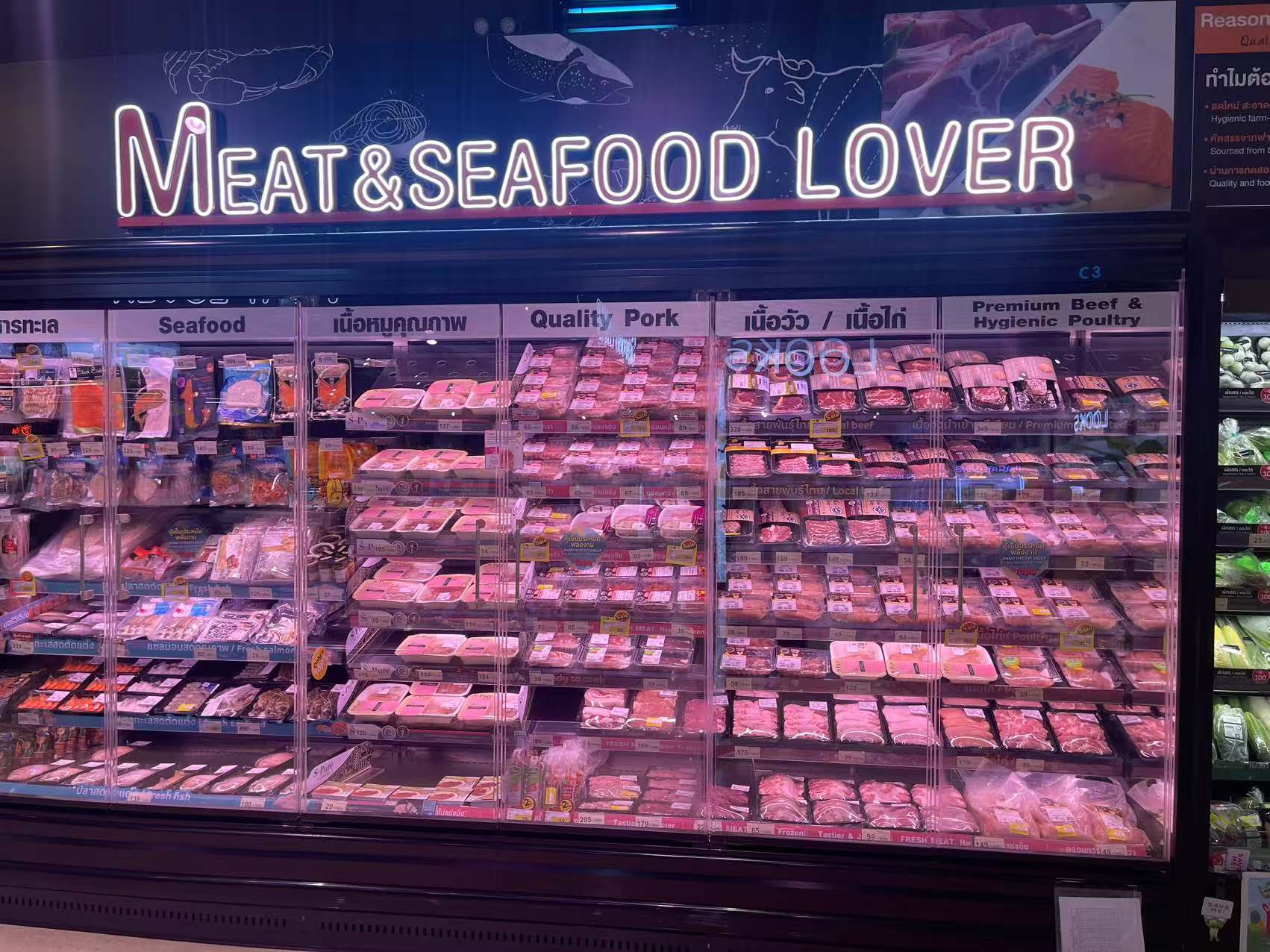
Upgrading lighting in an existing refrigerated display cabinet is rarely a matter of picking the brightest fixture. The cabinet’s original design, how the doors were installed, the voltage already in place, and the type of products on display all influence which solution will actually work.
Last week, a customer approached us with exactly this kind of retrofit request. Their five-shelf refrigerated display case was stocked with packaged meat and already equipped with a T8 canopy light. They wanted better illumination on every shelf and initially asked us to recommend pillar lights.
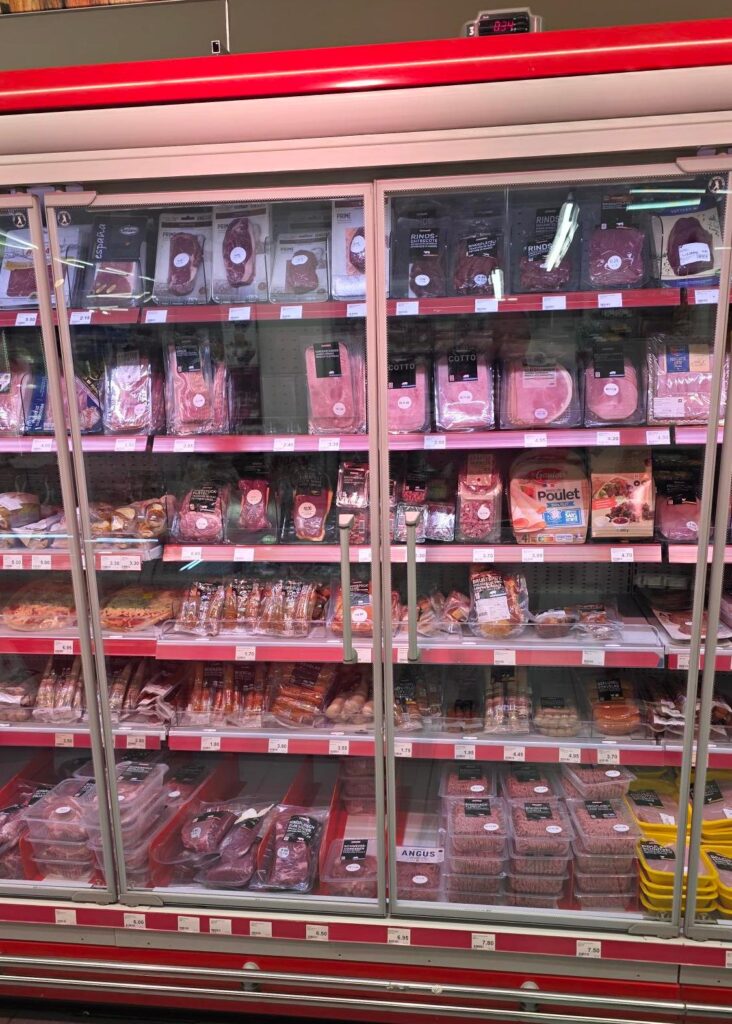
The Customer’s Cabinet: What the Photos Showed
From the photos, the cabinet was a vertical, glass-door refrigerated display case with five shelves. The glass doors appeared to have been retrofitted later: there was no full door frame, only the upper and lower frame sections fixed in place. The only existing light was a single T8 canopy light mounted at the top.
Because the doors were added after the cabinet was built, the structure lacked the side door frame normally used to mount pillar lights. This single detail became the turning point of the entire recommendation.
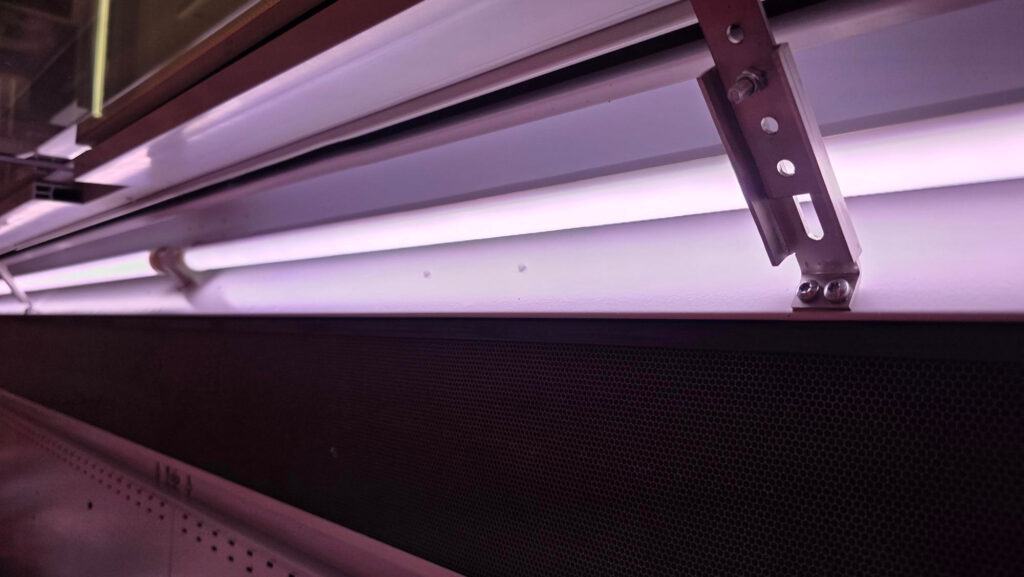
Why Pillar Lights Were Not the Straightforward Answer
Pillar lights can deliver excellent vertical illumination when installed along the door frame of a refrigerated display case. In this project, however, the retrofit came with clear trade-offs:
- No native mounting surface. Without a side door frame, we would need to add a guide rail to the existing frame first, then attach the pillar lights.
- Reduced glass transparency. Adding a frame-mounted rail and light column would visually break up the glass door area.
- Very short light-to-shelf distance. The installed pillar lights would sit extremely close to the shelf edges. Different Laidishine pillar light series perform very differently depending on the distance between the frame and the shelf.
- No on-site testing possible. Because we could not measure the actual lighting performance in the customer’s cabinet, we could not guarantee which pillar light series would give the desired result.
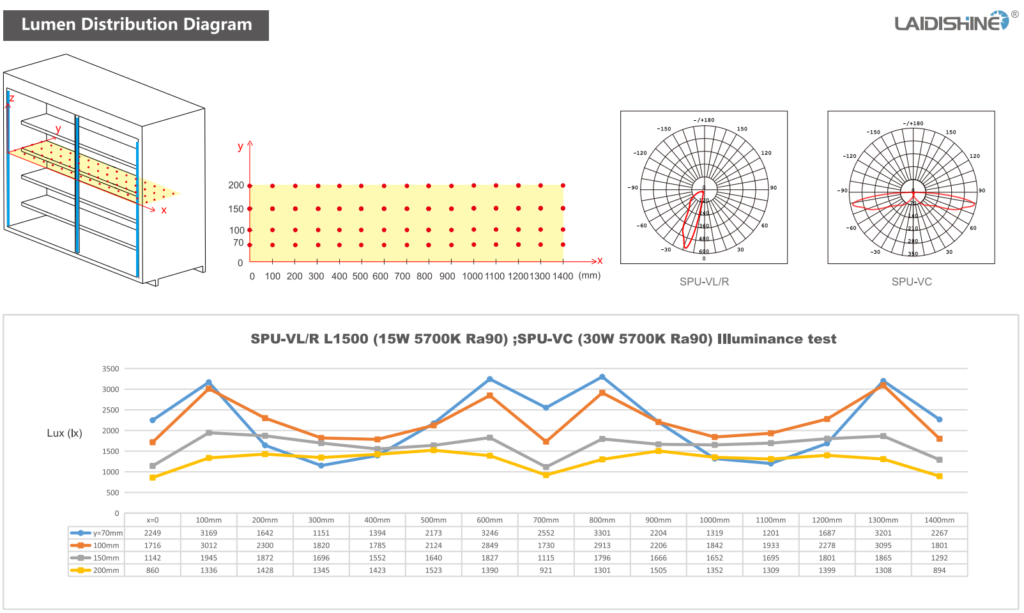
Rather than push ahead with an uncertain structural modification, we suggested the customer step back and consider two alternative approaches centered on the canopy light and shelf lights they already understood.
Two Alternative Lighting Approaches
Option 1: Keep the Existing T8 Canopy Light and Add Shelf Lights
The first proposal was to leave the top T8 light in place and add a shelf light under each of the five shelves.
- Advantage: The cabinet’s overall face lighting would remain, while each shelf would receive direct, even illumination from its own light source.
- Consideration: Shelf lights add wiring points and require adequate clearance from the product surface to avoid any thermal or color effects on fresh meat.
Option 2: Replace the Top T8 with the CNP High-End Canopy Light
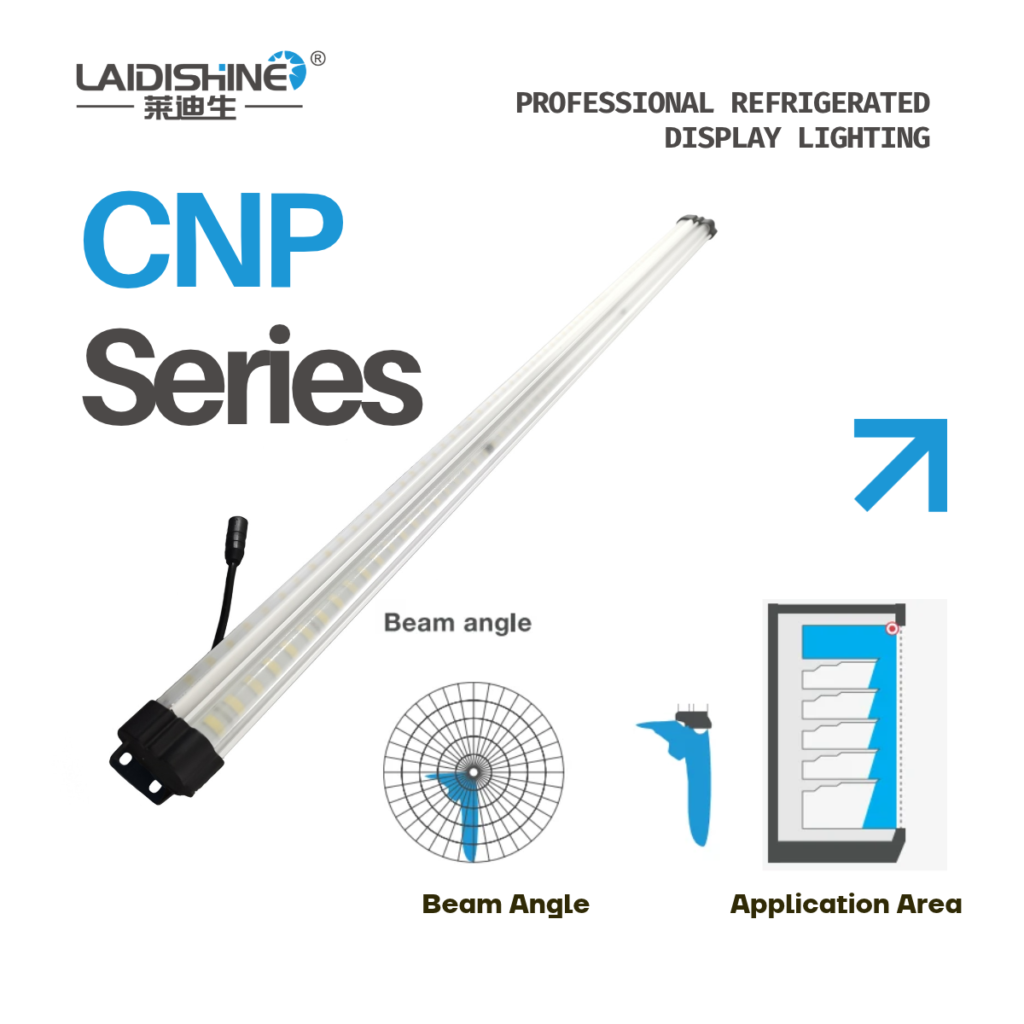
The second proposal was to replace the existing T8 with our CNP high-end canopy light. CNP uses a dual-tube design, and its photometric distribution is intentionally engineered for top-mounting in refrigerated display cases.
- Advantage: A single CNP tube can illuminate both the cabinet face and the product surfaces on the shelves below, giving a cleaner appearance than a mix of canopy plus shelf lights.
- Consideration: CNP is optimized for cabinets where the top light has a clear downward throw. In this customer’s unit, the installation location was in a corner, and a wide front baffle on the first shelf created a deep recess. That geometry risked blocking CNP’s inward-throwing light and offered no convenient place to secure the second tube.
Addressing the Customer’s Two New Concerns
After reviewing the two options, the customer raised two practical constraints:
- They did not want to convert from high voltage to low voltage.
- They were worried that adding shelf lights could change the color of the meat.
On Meat Color and Refrigerated Lighting
Meat discoloration in a display case can happen, but it is usually the result of a combination of factors: fixture heat, light intensity, and the spectral composition of the light—not simply the “color” of the light. (Refer to the article: How to choose the appropriate fresh meat light for a refrigerator)
Where shelf lights are used, the risk can be reduced by lowering the fixture power and increasing the distance between the light and the meat surface. That said, no supplier can guarantee that discoloration will never occur in every cabinet environment.
A High-Voltage Alternative: T8M
Because the customer wanted to stay with high voltage, we introduced our T8M series. T8M is a high-voltage LED tube built for refrigerated display applications.
- Wide beam angle. T8M’s distribution covers both the downward and inward directions from a top-mounted position, so one tube can reach the shelf fronts and the product faces below.
- Sufficient brightness for refrigerated cabinets. While it is not as optically concentrated as CNP, it delivers enough light for typical meat display cases.
- Waterproof rating suitable for refrigeration. T8M meets the moisture-resistance requirements of refrigerated environments.
- Cost-effective. For a retrofit where budget matters, T8M offers strong performance without the premium of a specialized canopy system.
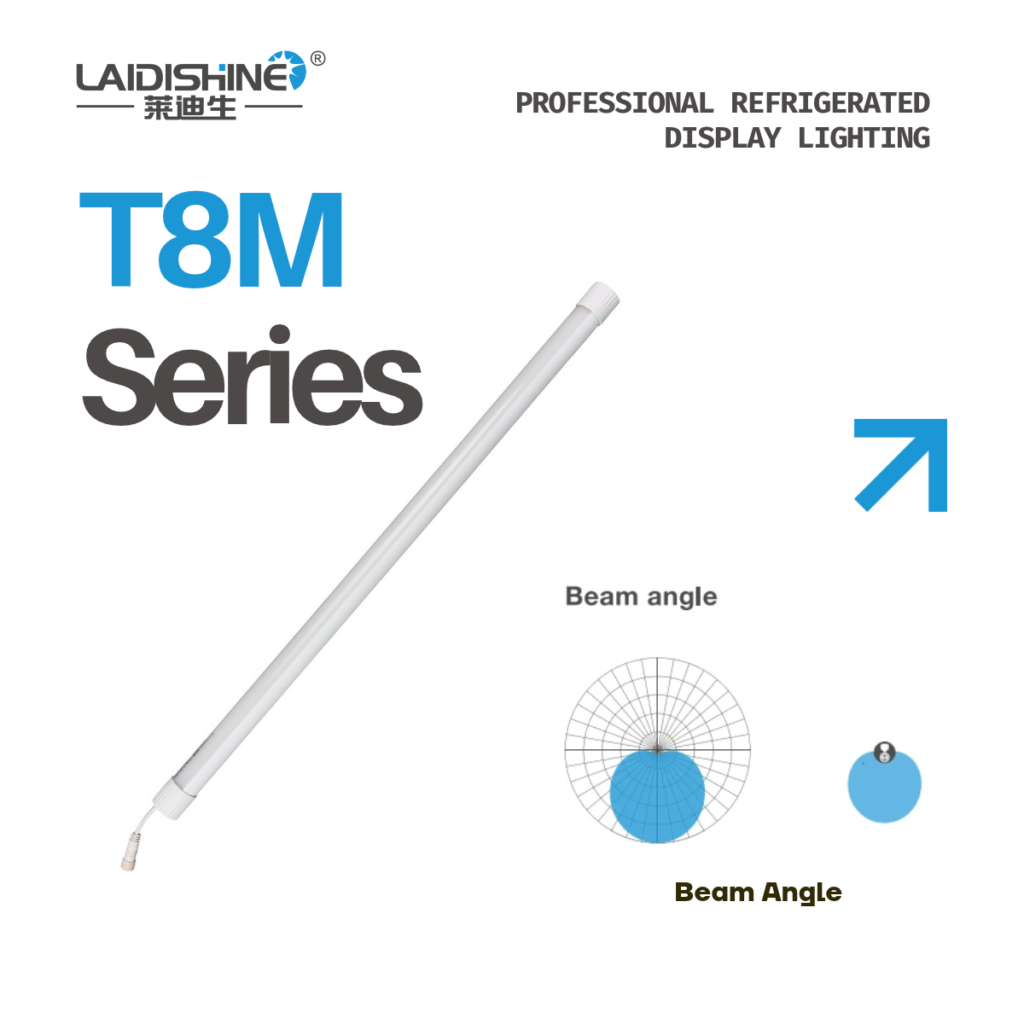
Crucially, the customer’s top installation location favored T8M over CNP. The recessed corner and the wide first-shelf baffle made CNP’s inward beam vulnerable to obstruction and left no reliable mounting point for the second tube. T8M’s broader, more forgiving beam fit the existing geometry better.
If the customer later still wanted to experiment with shelf lights, T8M would also work well as the top light in that combined layout, giving them flexibility to choose their final installation scheme.
Final Solution: T8M as the Canopy Light
The customer ultimately selected the T8M series as the replacement canopy light.
This choice meant:
- No cabinet structure changes. The existing top mounting location and T8-style hardware were reused.
- No voltage conversion. T8M operates on the customer’s existing high-voltage supply.
- Simple installation. Standard T8 connection cables and brackets completed the setup.
- Immediate usability. The cabinet could be relit with minimal downtime and no custom fabrication.
Key Takeaways for Your Own Retrofit
- Start with the cabinet, not the fixture. A lighting upgrade should be driven by the cabinet’s frame, door type, mounting positions, and voltage—not by the most eye-catching product.
- Pillar lights need the right door frame. If the frame is missing, retrofitted, or unusually shallow, the installation may compromise visibility and performance.
- Match the light to the mounting geometry. A deep recess or wide front baffle can favor a wider-beam tube like T8M over a tightly focused dual-tube canopy light.
- Protect product appearance. For meat displays, control heat, intensity, and spectrum; maintain adequate distance between the light source and the product.
If you are planning a refrigerated display cabinet lighting retrofit and are unsure whether pillar lights, shelf lights, or a canopy upgrade is the right path, share a few photos of your cabinet with our team. We can help you choose a solution that fits your structure, voltage, and product display goals—without unnecessary modifications.