When evaluating LED lighting for refrigerated displays, cold rooms, or commercial refrigeration equipment, you’ll often see claims such as:
- L80 @ 50,000 hours
- L90 @ 60,000 hours
- Rated lifetime: 50,000 hours
A common question from equipment manufacturers is:
“Has the LED really been tested for 50,000 hours?”
The answer is not necessarily.
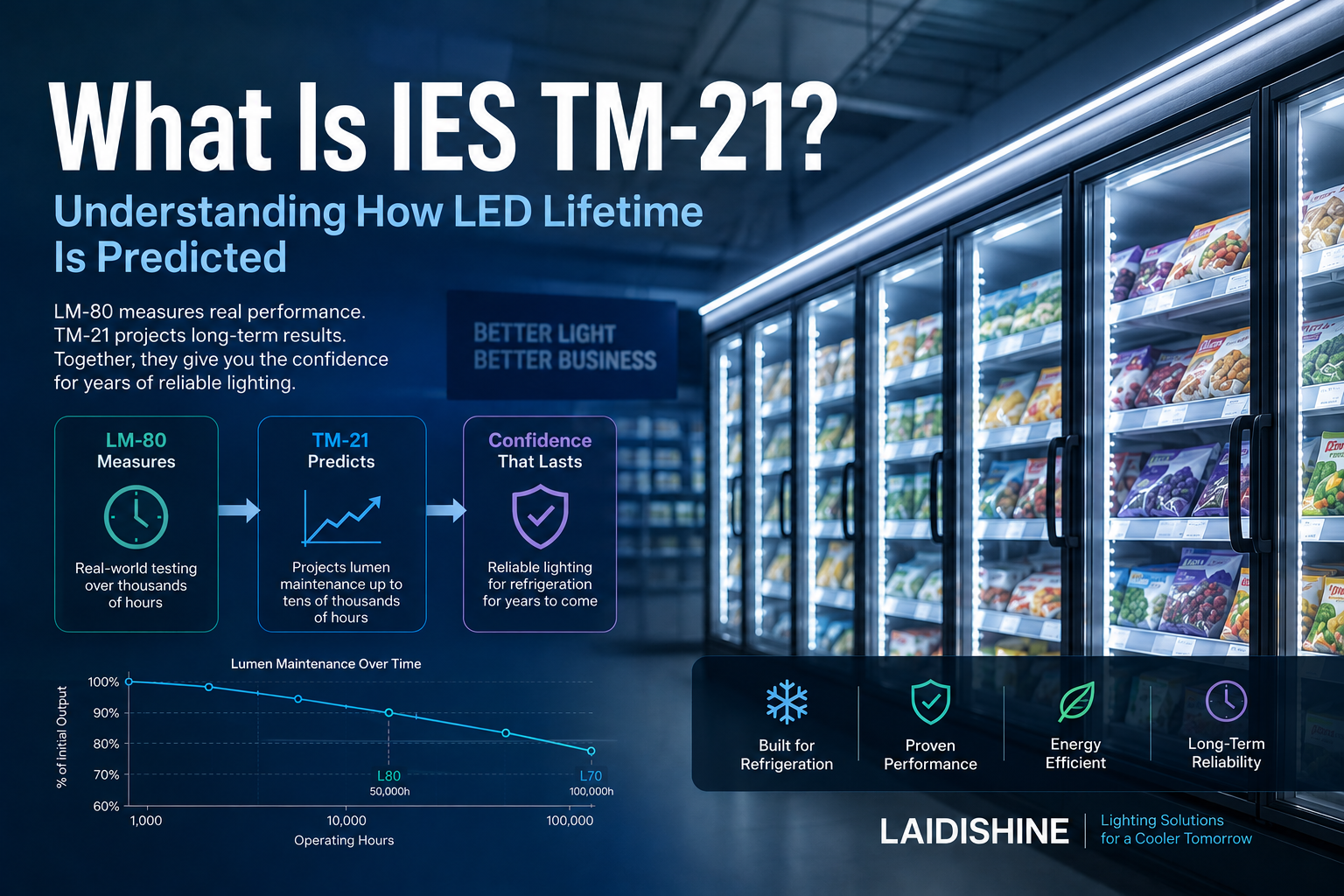
Instead of waiting more than five years to complete a real-time test, the lighting industry relies on internationally recognized methods to predict long-term LED performance. One of the most important of these is IES TM-21.
Why Lifetime Prediction Matters
For commercial refrigeration, lighting is expected to operate continuously for many years. Whether installed in supermarket display cases, glass-door freezers, or cold rooms, replacing failed lighting means maintenance costs, product disruption, and unhappy customers.
Because of this, manufacturers need reliable data—not marketing claims—to estimate how LEDs will perform over time.
That’s where LM-80 and TM-21 work together.
LM-80 Measures. TM-21 Predicts.
Although these two standards are often mentioned together, they serve different purposes.
LM-80: Real Performance Testing
IES LM-80 specifies how LED manufacturers test lumen maintenance over time.
LED packages or modules are operated continuously under controlled conditions, typically for 6,000, 10,000, or even 15,000 hours. During the test, engineers regularly measure how much light output the LEDs retain.
The result is a set of real performance data collected over thousands of hours.
TM-21: Lifetime Projection
Testing an LED for 50,000 or 100,000 hours would require six to eleven years of continuous operation.
Instead, IES TM-21 uses the measured LM-80 data to mathematically project long-term lumen maintenance.
For example:
- LM-80 test duration: 10,000 hours
- Measured lumen maintenance: 96%
- TM-21 projection: L90 beyond 50,000 hours
The important point is that TM-21 does not create lifetime claims from assumptions. It projects future performance based on actual measured data obtained through LM-80 testing.
What Does L70, L80 and L90 Mean?
These values describe how much light remains after a certain operating time.
| Rating | Meaning |
|---|---|
| L70 | 70% of the initial light output remains |
| L80 | 80% of the initial light output remains |
| L90 | 90% of the initial light output remains |
For commercial refrigeration, many manufacturers prefer L90 or L80 because display quality is directly affected by lighting performance. Even a moderate reduction in brightness can influence product presentation.
Why TM-21 Doesn’t Predict Forever
One common misconception is that TM-21 can predict any lifetime.
It cannot.
To maintain credibility, TM-21 limits how far engineers can project beyond the actual LM-80 test duration.
For example:
| LM-80 Test Duration | Maximum TM-21 Projection |
|---|---|
| 6,000 hours | 36,000 hours |
| 10,000 hours | 60,000 hours |
| 15,000 hours | 90,000 hours |
This limitation helps ensure that projected lifetime values remain technically justified rather than overly optimistic.
Does TM-21 Guarantee the Lifetime of an LED Fixture?
No.
TM-21 evaluates the LED light source itself, not the complete lighting fixture.
The overall lifetime of an LED luminaire also depends on factors such as:
- Driver reliability
- Thermal management
- Ambient operating temperature
- Component quality
- Mechanical design
- Environmental conditions
Even if an LED package can maintain excellent lumen output for more than 50,000 hours, poor thermal design or a low-quality driver may significantly reduce the service life of the entire fixture.
This is why system design is just as important as LED selection.
Why It Matters for Refrigeration Lighting
Commercial refrigeration presents unique operating conditions.
Although refrigerated displays operate at low temperatures, the LED driver and electronic components still generate heat. At the same time, refrigeration equipment experiences frequent compressor cycling, voltage fluctuations, and long operating hours.
A reliable lighting system therefore requires more than efficient LEDs.
It requires:
- High-quality LED packages with verified LM-80 data
- Proper TM-21 lifetime projections
- Effective thermal management
- Reliable LED drivers
- Careful optical and mechanical design
Only by considering the complete system can manufacturers achieve consistent lighting performance throughout the product’s service life.
Our Approach at Laidishine
At Laidishine, we design LED lighting specifically for commercial refrigeration applications.
When evaluating LED performance, we don’t rely solely on chip specifications. We also consider thermal design, driver selection, operating environment, and long-term reliability to ensure stable performance in demanding refrigerated environments.
Understanding standards such as LM-80 and TM-21 helps equipment manufacturers make informed decisions based on engineering data rather than marketing claims.
Because in commercial refrigeration, long-term reliability is measured not only by how bright a light is on day one—but by how well it performs years later.
About Laidishine
Laidishine specializes in LED lighting solutions for commercial refrigerated displays, glass-door merchandisers, cold rooms, and retail refrigeration equipment. Our products combine high optical performance, energy efficiency, and long-term reliability to help manufacturers deliver better merchandising and lower maintenance costs.