Ao especificar um sistema de iluminação LED para vitrines refrigeradas, refrigeradores walk-in, ou vitrines de supermercado, classificações de segurança são frequentemente discutidas juntamente com especificações elétricas, como tensão, poder, eficácia, e classificação IP.
Entre os termos mais comumente mal compreendidos estão Classe II e Aula 2.
Embora pareçam quase idênticos, essas duas classificações descrevem diferentes aspectos da segurança elétrica e são definidas por padrões diferentes. Confundi-los pode resultar na seleção incorreta do driver, revisões de design desnecessárias, ou desafios de certificação durante a aprovação do produto.
Compreender a distinção é essencial para OEMs, designers de iluminação, e fabricantes de equipamentos de refrigeração.
Duas classificações. Dois conceitos de segurança diferentes.
O primeiro passo é reconhecer que estas classificações têm origem em diferentes sistemas regulatórios.
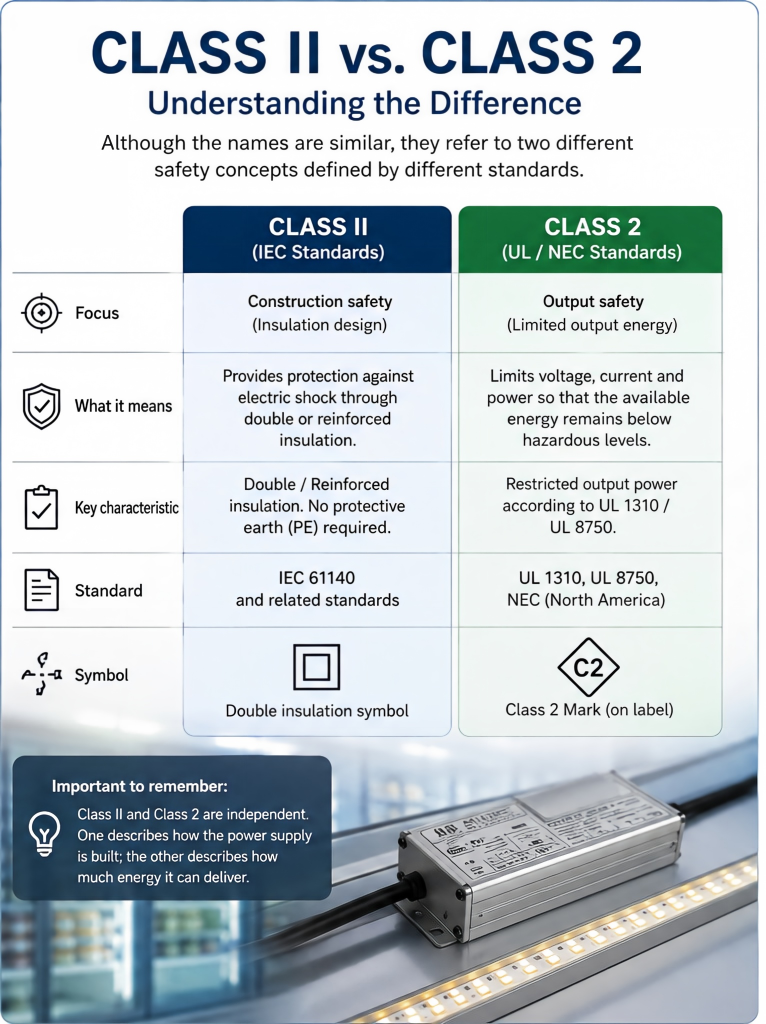
| Classe II | Aula 2 |
|---|---|
| Padrões IEC | Ul / Padrões NEC |
| Segurança na construção | Segurança de saída |
| Isolamento duplo ou reforçado | Energia de saída limitada |
Simplificando:
- Classe II descreve como uma fonte de alimentação é projetada.
- Aula 2 descreve quanta energia elétrica a fonte de alimentação pode fornecer.
São classificações independentes e nunca devem ser consideradas intercambiáveis.
Classe II: Proteção através de isolamento
Uma fonte de alimentação Classe II alcança segurança elétrica através isolamento duplo ou isolamento reforçado.
Ao contrário dos equipamentos Classe I, que depende de um condutor de aterramento de proteção, um design Classe II oferece proteção contra choque elétrico através de seu sistema de isolamento interno.
A classificação concentra-se na construção do equipamento e não na sua produção elétrica.
Para fabricantes de iluminação, isso significa avaliar fatores como:
- barreiras de isolamento
- distâncias de fuga e folga
- rigidez dielétrica
- construção de gabinete
- conformidade com os padrões de segurança IEC aplicáveis
Aula 2: Proteção através de energia limitada
Aula 2 é fundamentalmente diferente.
Definido sob os padrões de segurança norte-americanos, uma aula 2 fonte de alimentação limita sua tensão máxima de saída, corrente e potência para que a energia disponível permaneça abaixo dos limites de segurança especificados.
Em vez de confiar apenas no isolamento, Aula 2 reduz riscos potenciais, restringindo a energia disponível sob operação normal e condições de falha.
Para instaladores e projetistas de sistemas, isso geralmente oferece vantagens como:
- fiação secundária simplificada
- risco de incêndio reduzido
- menor risco de choque elétrico
- conformidade mais fácil com os requisitos de instalação norte-americanos
Se um motorista se qualifica como classe 2 depende inteiramente de suas características de saída certificadas – não de seu projeto de isolamento.
Por que a diferença é importante na iluminação de refrigeração
A iluminação de refrigeração comercial apresenta condições operacionais únicas.
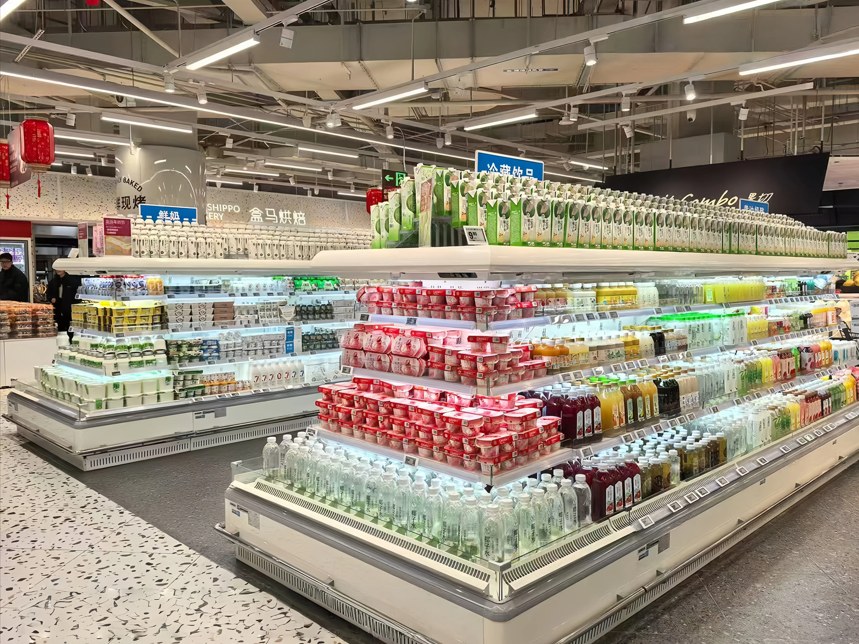
Os sistemas LED são normalmente instalados dentro:
- vitrines refrigeradas
- comerciantes de portas de vidro
- caixas de freezer
- refrigeradores walk-in
- equipamento de exibição de varejo de alimentos
Esses ambientes envolvem umidade, baixas temperaturas, gabinetes de metal e cabos longos, todos os quais exigem uma consideração cuidadosa da segurança elétrica.
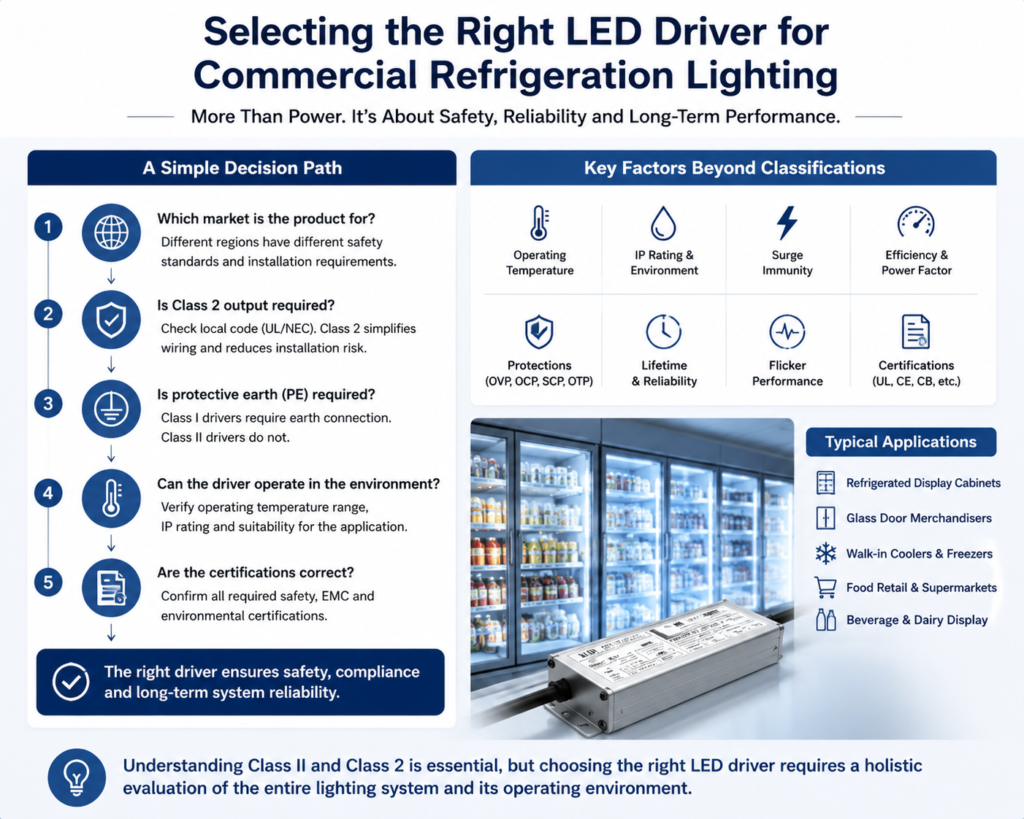
A seleção de um driver de LED envolve muito mais do que combinar tensão e potência.
Os engenheiros devem avaliar:
- classificação de segurança elétrica
- proteção ambiental (Classificação IP)
- faixa de temperatura operacional
- imunidade a surtos
- eficiência
- vida
- requisitos de certificação para o mercado-alvo
Um driver adequado para um mercado pode não satisfazer os requisitos regulamentares de outro.
Classe II não significa automaticamente classe 2
Um dos equívocos mais comuns é assumir que uma fonte de alimentação Classe II também é uma fonte de alimentação Classe II. 2 fonte de energia.
Isso não é necessariamente verdade.
Da mesma maneira, uma aula 2 fonte de alimentação não é automaticamente Classe II.
Estas classificações avaliam diferentes características de segurança.
Um endereço construção e isolamento.
Os outros endereços energia de saída disponível.
Ambos podem ser importantes dependendo da aplicação, mas nenhum substitui o outro.
Perguntas que os engenheiros devem fazer durante a seleção do motorista
Em vez de perguntar apenas:
“Este driver é Classe II?”
ou
“Esta é a classe do driver 2?”
Uma melhor abordagem de engenharia é perguntar:
- Para qual mercado o produto se destina?
- Quais padrões de segurança se aplicam?
- É uma aula 2 saída exigida pelo código de instalação?
- O equipamento requer aterramento de proteção?
- As certificações do motorista são apropriadas para todo o sistema de iluminação??
Responder antecipadamente a essas perguntas ajuda a evitar atrasos durante a certificação do produto e a instalação em campo.
Além do motorista: Projetando um sistema de iluminação LED confiável
O driver é apenas um elemento de uma solução confiável de iluminação de refrigeração.
O desempenho geral do sistema também depende:
- gerenciamento térmico
- Corrente operacional do LED
- projeto óptico
- arquitetura de fiação
- confiabilidade do conector
- resistência à umidade
- manutenção do lúmen a longo prazo
- compatibilidade entre o driver e a carga do LED
Um sistema de iluminação bem projetado equilibra a segurança elétrica, desempenho óptico e confiabilidade de longo prazo para alcançar desempenho consistente durante toda a vida útil do produto.
Conclusão
Embora Classe II e Aula 2 soa semelhante, eles descrevem conceitos de segurança fundamentalmente diferentes.
Compreender esta distinção permite que engenheiros e OEMs selecionem a fonte de alimentação apropriada, simplificar a conformidade, e construir sistemas de iluminação que atendam aos requisitos de seus mercados-alvo.
Para fabricantes de equipamentos de refrigeração comercial, considerar essas classificações no início do processo de projeto ajuda a garantir a conformidade regulatória e a confiabilidade do sistema a longo prazo.