
In the application scenario of commercial refrigerated LED lights, many customers tend to believe that a higher power of the light will result in greater brightness. Therefore, when we promote low-voltage lighting fixtures, customers pay great attention to luminous efficacy and are skeptical that such fixtures can achieve the existing brightness levels. So, is there a direct positive correlation between the power and brightness of commercial refrigerator lights?
Actually, this statement is not entirely accurate. Below is a detailed analysis of power, brightness, and the various factors that influence brightness.
I. Basic Concepts of Power and Brightness
Power, measured in watts (W), reflects the amount of electrical energy consumed by an electrical device. Brightness, on the other hand, is measured in lumens (lm) and refers to the total amount of light emitted by a light source. In simple terms, power focuses on energy consumption, while brightness centers on the quantity of light emitted.
II. Impact of Different Light Sources on Brightness
1. Traditional Light Sources
In traditional light sources, there is usually a positive correlation between power and brightness, meaning that a higher power generally leads to greater brightness. Take incandescent bulbs as an example. When the power is increased from 40W to 100W, there is a significant increase in brightness. However, incandescent bulbs have extremely low luminous efficiency, with most of the electrical energy being converted into heat and only a tiny fraction being transformed into light energy, resulting in a substantial waste of energy.
2. LED Lights
Nowadays, the vast majority of low-voltage LED freezer lights are in use on the market. However, for LED lights, a higher power does not necessarily mean greater brightness. The brightness of an LED is determined by both the current and the luminous efficacy, rather than solely by power. The following intuitive examples further illustrate this point:
Light A: 10W with a luminous efficacy of 100lm/W → Total brightness of 1000lm
Light B: 15W with a luminous efficacy of 80lm/W → Total brightness of 1200lm
In this example, Light B has a higher power and indeed has greater brightness.
Light C: 10W with a luminous efficacy of 120lm/W → 1200lm
Light D: 15W with a luminous efficacy of 70lm/W → 1050lm
In this case, Light C has a lower power but is brighter than Light D.
III. The Impact of Polarization Technology on the Brightness of LED Lights
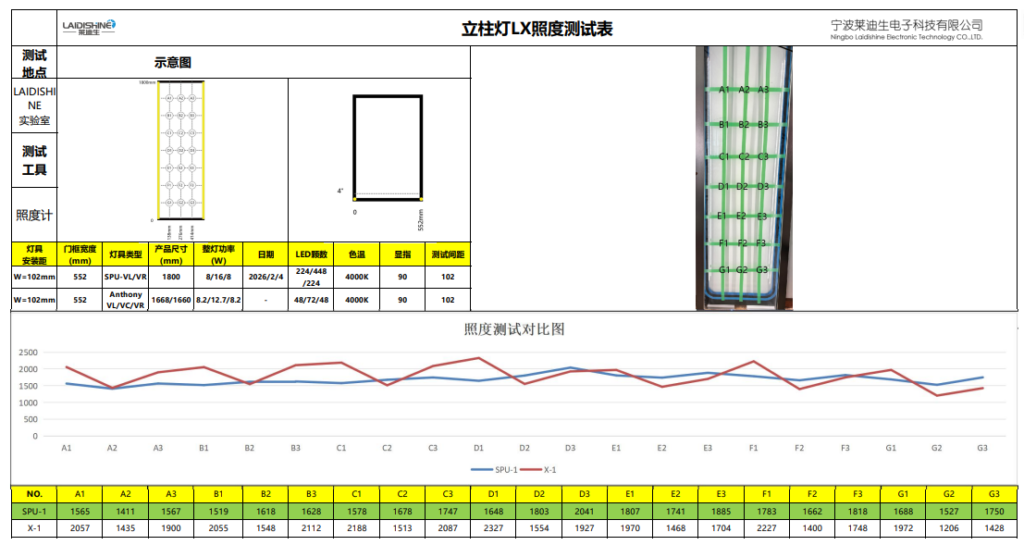
High-quality freezer lights often incorporate advanced polarization technology. The core principle of this technology lies in using lenses to focus the light, precisely converging the light onto the product area that needs to be illuminated, thereby effectively enhancing the brightness in that specific area. However, this technology also presents a pressing challenge in practical applications: under the focusing effect of the lenses, the light is concentrated in the product area, causing the brightness at both ends of the light fixture to be significantly dimmer compared to the middle part, which affects the overall uniformity of the lighting effect.
Below is a real-world case study of a successful service provided by Laidishine. Previously, when we designed a lighting solution for a sliding-door freezer for a customer, the customer clearly specified the requirements of low power and high luminous efficacy. During a comparative test, the lighting fixtures originally used by the customer (indicated in red in the diagram) exhibited obvious problems of uneven brightness. In contrast, Laidishine’s SPU series freezer lights (indicated in blue in the diagram), with their unique design and technological advantages, demonstrated a more uniform distribution of light efficacy, perfectly meeting the customer’s demand for high-quality lighting.
In conclusion, in the field of lighting, it cannot be simply assumed that higher power leads to greater brightness; instead, luminous efficacy is the key factor determining brightness.