-Showcase-scaled.jpg)
Proper illumination is critical for commercial refrigerators. It’s not just about visibility; it’s about presentation, safety, and driving sales. The right lighting makes products look fresh, vibrant, und ansprechend, directly influencing a customer’s purchasing decision. While top and vertical lighting are common, a key question often arises: Does your cabinet need dedicated horizontal lighting?
This guide will help you determine the answer, explain the requirements for horizontal fixtures, and highlight how Laidishine’s advanced solutions outperform standard market offerings.
1. How to Determine if Your Cabinet Needs Horizontal Lighting?
The need for horizontal lighting primarily depends on your cabinet’s design, shelving layout, and the desired visual impact. Here’s a professional breakdown:
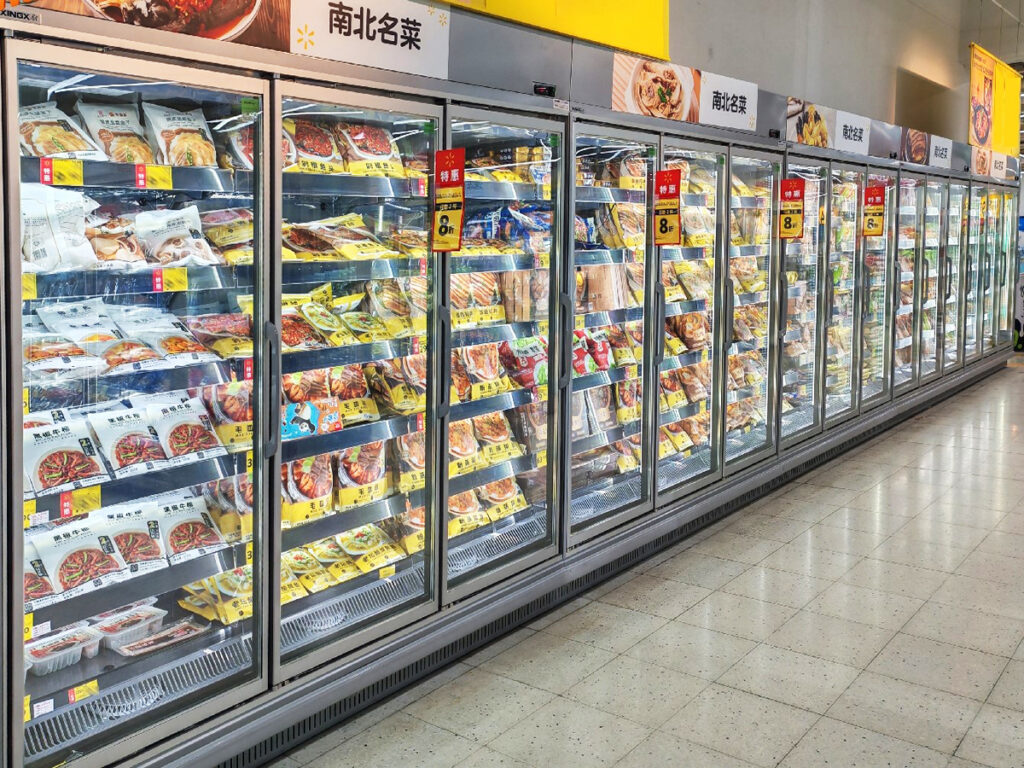
For Maximum Visual Impact: Common cabinet types like refrigerated display showcase open, sliding-door cabinets, and semi-height cabinets often benefit significantly from horizontal lighting. When aiming for superior, shadow-free illumination, integrating horizontal shelf lights with vertical door-frame lighting is a best practice. This combination strategically targets light from multiple angles, effectively eliminating dark spots and creating a bright, uniformly lit display that showcases every product layer.

When It Might Be Optional: In cabinets with closely spaced, compact shelving, the light from overhead (top-mounted) and vertical (upright) fixtures may be sufficient to meet basic visibility needs. If these primary sources adequately illuminate all products without casting significant shadows on lower shelves, adding horizontal lighting could be an optional enhancement rather than a necessity.
The Professional Verdict: Beyond specific customer requests, the decision should be driven by a practical lighting analysis. Zu den Schlüsselfaktoren gehören:
- Illumination Zone Coverage: Does light reach the back of deep shelves?
- Lighting Angles: Are products on lower shelves shadowed by those above?
- Uniformity: Is there a stark contrast in brightness between the top and bottom shelves?
If your analysis reveals gaps in coverage or uniformity, and if the cabinet structure allows for installation, adding horizontal lighting will dramatically elevate the cabinet’s overall luminous efficacy and visual appeal.

2. Key Requirements & Characteristics of Horizontal Lighting for Commercial Refrigeration
Horizontal lighting in cold environments isn’t standard. Fixtures must be engineered to perform reliably and effectively under specific demanding conditions.
Types of Horizontal Lighting:
It can be installed in two main locations: Top-mounted Horizontal Lighting: Placed at the cabinet’s top front edge; Under-shelf Horizontal Lighting: Mounted on the front edge of each shelf.
Functional Requirements:
A top-mounted horizontal light has a dual role: it must directly illuminate the first (top) shelf while also projecting a beam downward to brighten the surfaces of lower shelves.
jedoch, physics presents a challenge: Due to the Inverse Square Law, light intensity diminishes rapidly with distance. Each successive lower shelf receives exponentially less light from a single top source. Außerdem, even for uniformly aligned shelves, the angle of incidence increases for lower and front-edge areas, making them appear darker due to beam spread and potential shadowing from upper shelf rims. Simply increasing the shelf width downward doesn’t solve the core issue of light attenuation.
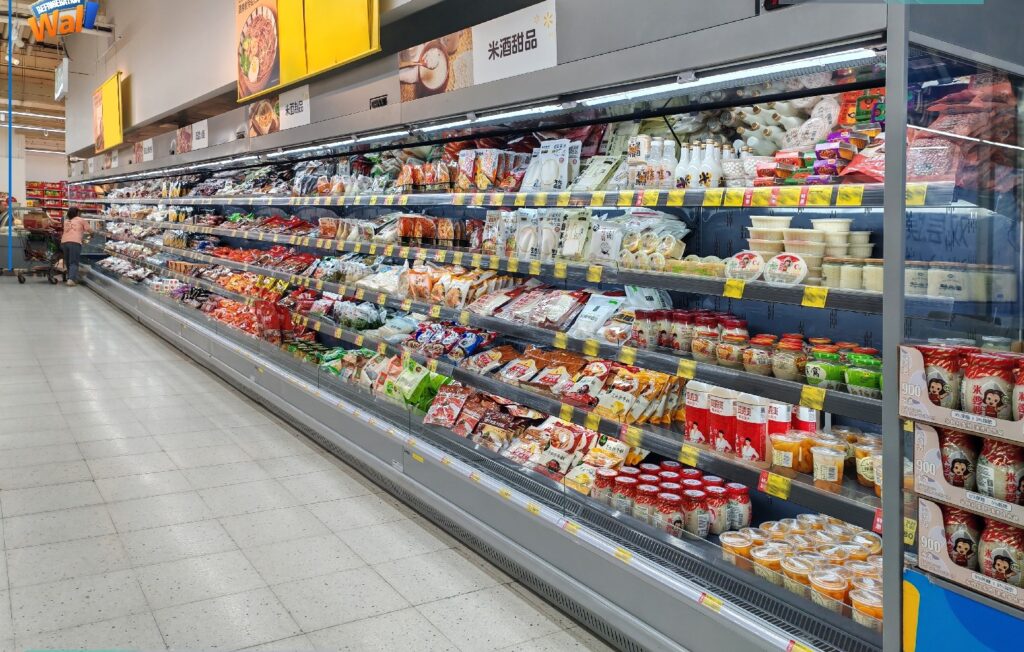
This is precisely where dedicated under-shelf horizontal lighting becomes essential. By providing a dedicated, close-proximity light source for each tier, it perfectly solves the problem of uneven illumination. It ensures consistent, high-quality light across every shelf, guaranteeing all products are displayed in their best light.
3. Common Drawbacks of Standard Horizontal Lighting on the Market
Many conventional horizontal lighting solutions suffer from significant shortcomings that can compromise display quality and operational efficiency:
Poor Luminous Efficacy & Low Brightness: Inefficient light output fails to adequately illuminate products.
Low Color Rendering Index (CRI): With a typical CRI below 80, colors appear washed out and unnatural, making food look less fresh and appealing.
High Power Consumption & Energy Inefficiency: Older technologies (z.B., fluorescent) or poorly designed LEDs consume more power for less light, increasing operational costs.
Complex Installation & Wiring: Bulky fixtures and non-standardized connectors lead to difficult, time-consuming installations with messy cable management.
Harsh Glare & Poor Light Distribution: Undiffused light creates eye-stopping glare for customers and “hot spots,” ruining visual comfort and uniformity.

4. The Laidishine Advantage: Engineered for Excellence
Laidishine’s horizontal lighting solutions are specifically designed to overcome these market deficiencies, offering superior performance, Zuverlässigkeit, and value.
Superior Color Rendering for Enhanced Appeal
Our products feature a high CRI 90+. This means our lights reproduce colors with exceptional accuracy and vibrancy. Red meats appear fresher, greens look crisper, and packaged goods’ colors pop. This heightened visual appeal is a proven driver of customer engagement and sales.
Smart, Cost-Effective Connectivity Solutions
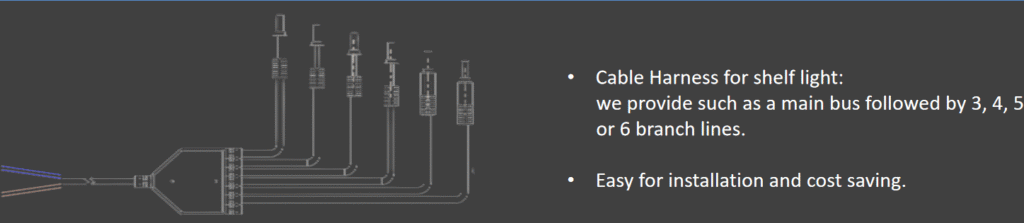
We understand the installation challenges posed by shelf supports and varying cabinet geometries. Instead of complicated daisy-chaining with exposed wires, we recommend an optimized approach: Single-Ended Input Fixtures. Our horizontal shelf lights are designed with a single connection point.
Streamlined “One-to-Many” Harness System: We provide custom harnesses that cleanly and efficiently connect a series of lights on one shelf column to a single main cable. For multi-column setups, each column’s harness connects to a centralized, adequately powered driver. This system minimizes visible wiring, reduces installation time and material waste, and allows one driver to power an entire cabinet—maximizing cost-efficiency and aesthetic cleanliness.
Flexible Optical Choices for Customized Results
We offer both transparent (Spu-H) and frosted (SPU-HB) cover options, allowing you to tailor the lighting to your specific application:
Transparent Cover: Delivers maximum brightness and direct illumination, ideal for deep cabinets where light penetration is critical.
Frosted (Milky) Cover: Provides soft, diffused, glare-free light. This is the preferred choice for customer-facing displays where visual comfort and eliminating harsh reflections are paramount, creating a pleasant shopping experience.
Built for the Cold:
Engineered with components rated for low-temperature operation, ensuring stable performance, instant start-up, and long lifespan even in sub-zero environments—a non-negotiable requirement that many generic lights fail to meet.

5. Determining the need for horizontal lighting requires a careful look at your cabinet’s design and goals. While not always mandatory, it is the definitive solution for achieving uniform, high-quality, shadow-free illumination across all shelf levels. When you choose horizontal lighting, choosing Laidishine means moving beyond basic functionality. It means investing in vibrant product presentation, simplified installation, Energieeinsparungen, and a superior overall visual experience for your customers. Our solutions are not just lights; they are strategic tools for enhancing retail performance.
Upgrade your display. Choose Laidishine Illumination.